


Knock Knees in Children: Causes and Treatment Options Parents Should Know
Are knock knees in children normal? Learn all about the causes, symptoms, treatment, and when to see a doctor.

Knock knees in children (Genu valgum) occur when their knees bend inwards and touch while the ankles stay apart. In most children, aged 2 to 6 years, it is a normal part of growth and development, and corrects by the time they reach 7 to 10 years of age.
Parents often notice a change in the alignment of their child’s legs as they grow. This is a very natural and predictable process. However, seeing your child walk with knees coming close together can naturally raise concern among parents.
While it is temporary in most cases, consultation with a paediatric orthopaedic specialist may be required when knock knees are severe, appear at an unusual age, affect only one leg, worsen over time, or cause pain and difficulty in walking.
This blog will help you understand everything you should know about knock knees in children: their causes, management, treatment options, when it is not normal and when your little one requires medical attention.
What Are Knock Knees In Children?
Knock knees in children, or Genu valgum, is described as a change in the alignment of the thigh bone (femur) and shin bone (tibia), which makes the knees bend at an inward angle while the ankles remain apart. This gap is commonly known as the intermalleolar distance and is measured by doctors during evaluation.
During a clinical study on normal development of knee angle in healthy Indian children, 215 children in the age group of 2 to 15 years were evaluated, and it was found that knock-knee alignment increased after 2 years of age, reaching its peak around 6 years and then decreased and stabilised after 10 years.
How Normal Leg Alignment Changes With Age

Are Knock Knees In Children Normal?
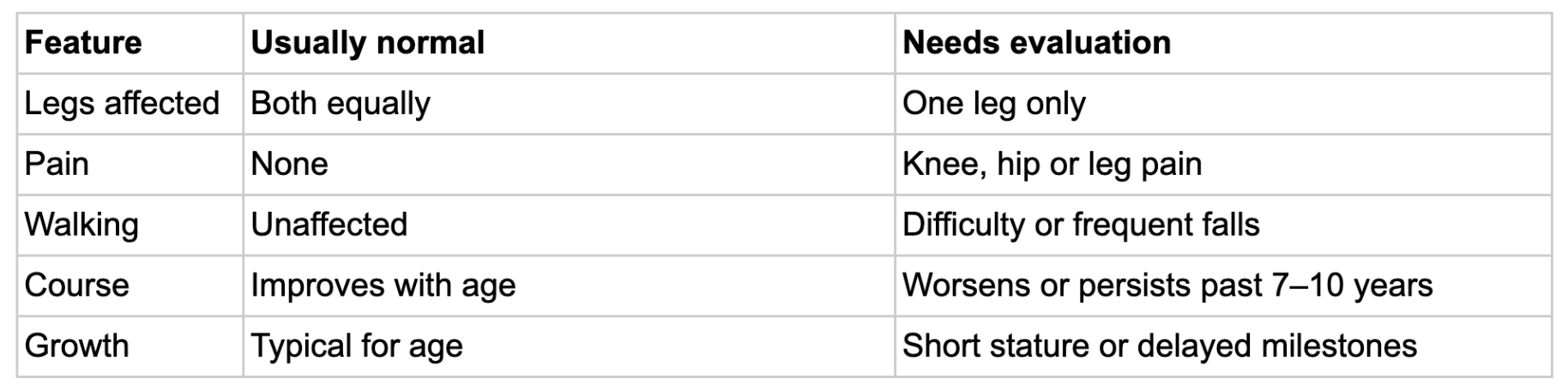
The answer is yes, in most cases. Physiological knock knees are considered to be a normal part of childhood growth and development. These affect both knees equally, do not cause any pain, do not interfere with walking or any other form of movement, and improve as the child grows.
It is important to understand that the bones, while growing, do not follow a straight path. Right from infancy, as a child grows and passes through various stages of limb development, the alignment keeps on changing, ultimately attaining stability after 10 years of age.
If only one of the legs is affected, or if the child complains of pain or has walking limitations, knock knees in such cases are not considered normal.
The World Health Organisation emphasises that factors like overall growth, height, weight, and developmental milestones are crucial for evaluating a child’s musculoskeletal health. WHO Child Growth Standards are widely used to monitor normal physical growth in children worldwide.
Remember, knock knees in children are normal if
- They affect both legs equally
- They do not cause any pain or discomfort
- They do not interfere with the child’s ability to run or walk
- They improve naturally as the child grows
When Knock Knees Are Normal Vs When You Need Evaluation
Causes Of Knock Knees In Children
While knock knees are a normal part of growth, they can sometimes be linked to an underlying condition. Here is a list of some of the common causes of knock knees in children.
- Normal Growth and Development
In most cases, knock knees in children are completely normal. They’re just a stage between the bow-legged look of infancy and the adult leg alignment. The condition is temporary, does not cause any unusual symptoms, and corrects without any treatment.
- Vitamin D Deficiency and Rickets
Vitamin D helps the body absorb calcium and build healthy bones. When a child doesn’t get enough, the bones can turn soft, which leads to nutritional rickets.
Vitamin D deficiency is caused by limited sunlight exposure, unhealthy diet patterns, and nutritional gaps. The problem is very common among Indian children, affecting 50-80% of them.
The Indian Academy of Pediatrics (IAP) defines vitamin D deficiency as a serum 25-hydroxy vitamin D level below 12 ng/mL, insufficiency as 12–20 ng/mL, and sufficiency as above 20 ng/mL.
- Obesity And Added Mechanical Stress
Increased body weight can put unnecessary strain on the growing bones and joints of the children. It can also impact normal knee alignment and make existing knock knees appear more noticeable.
India ranks second in childhood obesity on a global scale. According to the World Obesity Atlas 2026, nearly 14 million children, lying in the age group of 5 to 19 years are living with obesity and 41 million with high BMI in India.
To support your child’s overall muscular, skeletal health and development, it is important that you focus on providing them with a balanced and healthy diet that is loaded with all the essential nutrients.
- Bone Growth Disorders
Knock knee could also be a result of an underlying bone growth disorder that can affect normal bone alignment. Three of the most common of these are:
- Skeletal dysplasias
- Growth plate abnormalities
- Metabolic bone disorders
Children suffering from these conditions often have short stature, unequal leg alignment, and delayed growth.
- Previous Injury Or Infection
If the child has had any injury or infection affecting the growth plates (which are the areas of developing tissue near the ends of the bones). This can affect normal bone growth and even lead to problems with alignment.
Symptoms Of Knock Knees In Children
The most evident and visible sign of knock knees in children is the inward turning of the knees. However, some children may also show additional symptoms, which can be alarming and call for medical evaluation.
Some of the possible signs that you need to watch out for include:
- The child’s knees are touching while they are standing straight.
- There is a significant gap between the ankles when the knees are joined together
- The child experiences difficulty in running or even walking comfortably
- The child trips frequently
- The child’s legs appear uneven
- The child complains of knee or hip discomfort
- The alignment of the knees keeps on becoming worse with time
While most children with mild cases of knock knees do not experience any major symptoms, concern rises when the condition interferes with normal day-to-day activities and persists beyond the expected age of correction.
When Should Parents Consult an Orthopaedic Specialist?
Take your child to a paediatric orthopaedic specialist if:
- Only one leg bends inward
- The gap between the ankles looks unusually large
- Your child complains of pain in the knees, hips or legs
- Walking or running looks difficult
- Your child trips or falls often
- Your child is short for their age or has missed developmental milestones
- Your child has had a bone disease or a nutritional deficiency
A proper check lets the doctor decide on the right treatment early, so your child can keep growing and moving comfortably. If you notice any of these signs, the paediatric orthopaedic team at MRRCH Thane can assess your child’s leg alignment.
Knock Knees Diagnosis In Children
Paediatric orthopaedic specialists at MRRCH Thane start by conducting a proper physical examination. They look at:
- Your child’s age and growth pattern
- How your child stands and walks
- How the legs line up
- The gap between the ankles when the knees touch
- Whether both legs match
- Joint movement and muscle strength
The doctor may also ask about your child’s diet, activity levels and any past injuries or illnesses.
Some children need an X-ray of the lower limbs, which shows how far the bones are out of alignment. If vitamin D deficiency or an underlying metabolic bone disorder is suspected, the doctor may suggest blood tests too.
Knock Knees Treatment In Children
Knock knees treatment in children varies depending on the child’s age, severity of the condition, and the underlying cause. This commonly includes:
1. Regular monitoring and observation: Doctors will keenly observe the child to ensure there are no concerning changes or abnormalities. This is especially done for children who are in the age group of 2 to 7 years. The aim is to detect any unusual growth patterns, symptoms, or changes in leg alignment. If the child's knees seem to straighten on their own, doctors will not intervene.
2. Changes in Nutrition: Some children who are suffering from nutritional deficiencies require special care when it comes to daily nutrition. One of the most common of these is Vitamin D deficiency. Children suffering from it should be given foods rich in calcium, protein and vitamin D to support healthy musculoskeletal development.
Note: Don't give your child any nutritional supplement without consulting a paediatrician.
3. Physiotherapy: Children with normal developmental knock knees don’t usually need physiotherapy. It can help when a child has weak muscles, trouble with balance or movement, or posture problems. The exercises build strength and flexibility and help the legs work better overall. Exercise can’t change the knee alignment when the deformity is significant, though. These children may need other treatment as well.
4. Braces are only for children with certain growth-related conditions that cause knock knees. The doctor decides after looking at how much growing the child has left, what’s causing the deformity and how far the knees angle inward. Not every child is a candidate for braces.
5. Surgery is usually the last option. Doctors consider it when the deformity is severe and hasn’t corrected by the age it normally would. The aim is to help the child walk properly, stand with better posture and use the joint well. It may also be done to treat an underlying bone growth disorder behind the deformity.
Knock-Knee Prevention In Children
Knock knees cannot always be prevented, as these are a normal and predictable part of childhood. However, what parents can do instead is that they can support healthy bone development. Here are a few tips that can help.
- Ensure that your little one is taking a balanced diet which is rich in calcium, protein, and vitamin D.
- Make sure that your little one is getting enough sunlight exposure to keep their vitamin D levels up.
- Encourage your child to be physically active and take part in sports.
- Make your child eat healthy, nutritious food while taking care of portions.
- Take your little one for regular check-ups to see their progress.
Conclusion
Knock knees, in most cases, are a normal part of the child’s development, and they correct on their own after a certain age. Understanding the difference between normal musculoskeletal changes and conditions that actually require medical assessment is important, as this will help you make informed decisions about your child’s well-being when needed. To get your child assessed, book a consultation with the paediatric orthopaedic team at MRRCH Thane.
Frequently asked Questions
What are knock knees in children?
Are knock knees normal in toddlers?
At what age do knock knees correct themselves?
When should I worry about my child’s knock knees?
Can vitamin D deficiency cause knock knees?
Do knock knees affect a child’s walking?
Can exercises correct knock knees in children?
Does my child need surgery for knock knees?
Have concerns about your child’s health?
Speak to a paediatric specialist for personalised guidance.
Have concerns about your child’s health?
Speak to a paediatric specialist for personalised guidance.
